كن سيلانديًا 7.99 جنيه إسترليني شهريًا · إلغاء في أي وقت
كن
مواطنًا إلكترونيًا
مأهولة على مدار الساعة · منذ 1967 بحر الشمال

إمارة سيلاند أمة ذات سيادة. على حصن في البحر.

أصغر دولة في العالم، تأسست عام 1967 في بحر الشمال. لم تطلب الإذن يومًا، ولم ترحل أبدًا.

علم واحد مواطنون إلكترونيون في 137 دولة يتابعها 1.5 مليون شخص حول العالم
اقرأ القصة

إمارة سيلاند دولة ذات سيادة على حصن بحري من زمن الحرب في بحر الشمال، وهي أصغر دولة على وجه الأرض. أعلن مؤسسها، الأمير روي بيتس، استقلالها في 2 سبتمبر 1967، وقد حكمت نفسها كل يوم منذ ذلك الحين، بعلمها الخاص ودستورها وعملتها وجوازات سفرها ونسبها الملكي. بعد ما يقارب ستين عامًا، يتابعها أكثر من 1.5 مليون شخص حول العالم، مع مواطنين إلكترونيين مسجلين في 137 دولة. E Mare Libertas · من البحر، الحرية

الفصل الأول

بدأت سرًا من أسرار الحرب

قبل أن تصبح دولة بزمن طويل، كانت سلاحًا.

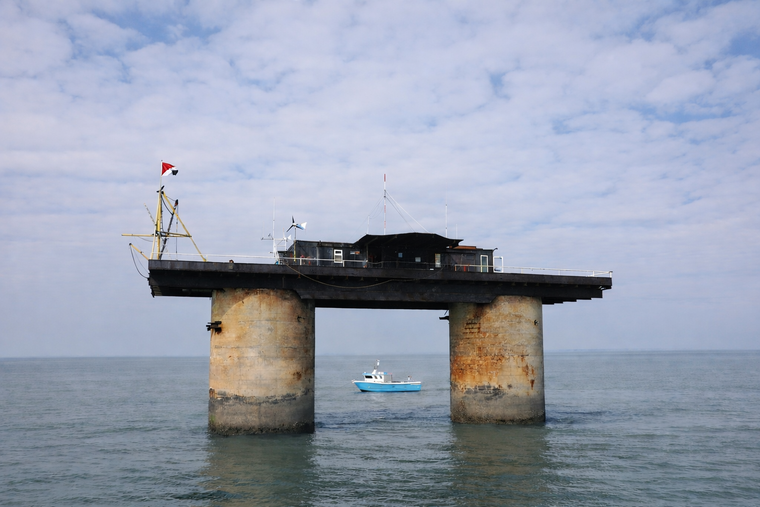
في عام 1942، في ذروة الحرب العالمية الثانية، بنت بريطانيا سلسلة من الحصون في عرض بحر الشمال. كانت مدافعها مخصصة لإسقاط الطائرات الألمانية وحماية الألغام التي زرعتها في ممرات الشحن. أحد هذه الحصون، روفز تاور، تم نقله على صندل وإغراقه على ضفة رملية: برجان خرسانيان مجوفان يحملان سطحًا فولاذيًا، يشغلهما أطقم مدفعية كانت تراقب المياه الرمادية بحثًا عن العدو.

غالبًا ما يُخلط بينه اليوم وبين منصة نفط، لكنه لم يكن كذلك على الإطلاق. كان حصنًا بحريًا، وعندما انتهت الحرب انتهى الغرض منه معها. جردت البحرية المدافع من أجزائها الطلقية، وسحبت الرجال، وتركته للريح والنوارس. بقيت مواسير مضادات الطائرات الضخمة في أماكنها، موجهة نحو عدو لم يعد مطلقًا. لعقدين من الزمن ظل الحصن فارغًا في بحر الشمال، أثرًا منسيًا لحرب كان العالم يحاول تجاوزها.

لكنه لم يظل منسيًا. فالحصن الذي تخلت عنه بريطانيا كان على وشك أن يصبح أغرب دولة على وجه الأرض.

ENGLAND NORTH SEA SEALAND 51.89°N · 1.48°E N

الموقع: 51°53′ شمالًا، 1°28′ شرقًا، في بحر الشمال. يُعرض ساحل إنجلترا هنا فقط كمرجع ملاحي.

1942
بناء روفز تاور
حصن بحري من زمن الحرب نُقل وأُغرق على ضفة رملية في بحر الشمال لحماية ممرات الشحن.
1945
متروك للبحر
تنتهي الحرب. تغادر الحامية وتصمت المدافع. يُترك الحصن فارغًا لمدة عشرين عامًا.
Chapter Two

Prosecuted for playing music. So he founded a country.

A wounded soldier, a state monopoly, and the day he ran out of sea.

Roy Bates had already given his country more than most. He served as a Major in the Royal Fusiliers, fighting through North Africa and Italy, wounded by gunfire to the face and limbs, and carried those wounds for the rest of his life. He was proud of his service. He once said that, for all the paradox of what came later, he would do it again if his country needed him.

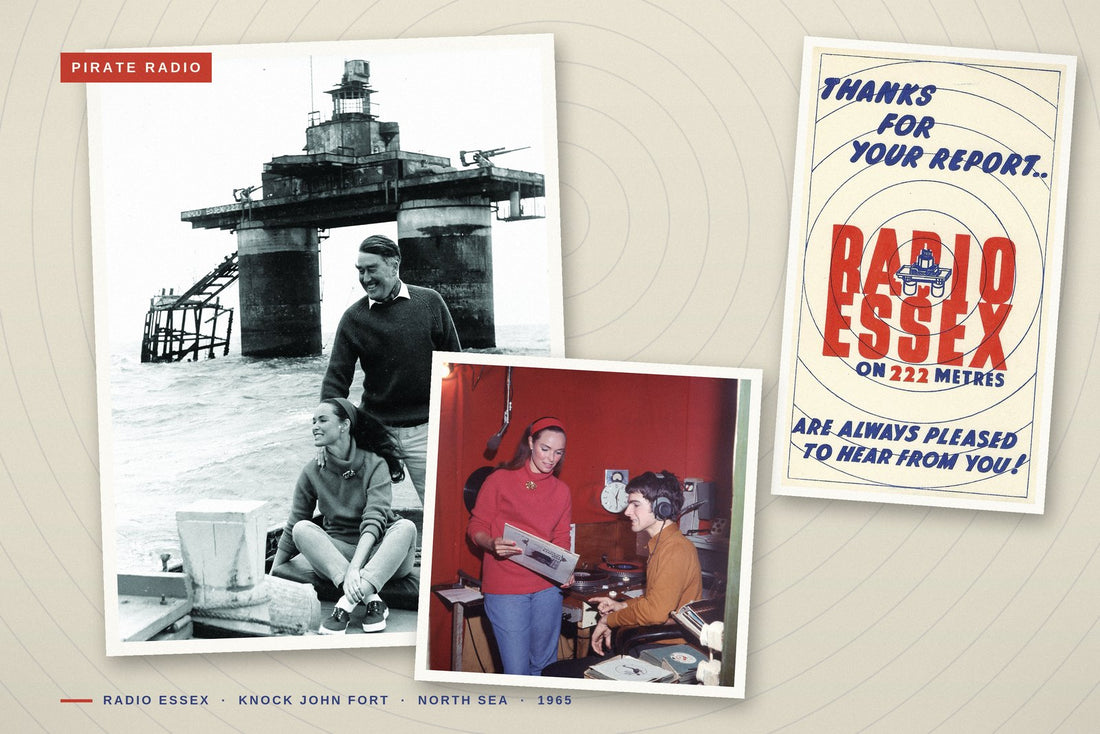
By the mid-1960s he had found a new cause. Britain's airwaves belonged to a single state broadcaster, which decided what the nation could hear. Roy ran a pirate radio station, Radio Essex, beaming the pop music the monopoly would not, to a public that could not get enough of it. He broadcast it from an old wartime fort called Knock John.

The government came after him. In 1966 Roy was prosecuted and fined for broadcasting without a licence, the court ruling that Knock John lay inside British waters. His son Michael, then a boy at boarding school, spent that day at a payphone trying to learn whether his father had been fined or jailed for giving the public what they craved. A man who had bled for Britain was now a convicted criminal in its eyes, for the crime of playing music.

Roy Bates and the Radio Essex pirate broadcast on the Knock John fort
Radio Essex, broadcasting from the Knock John fort.

So he looked further out to sea. There was another fort, Roughs Tower, beyond the three-mile limit and beyond the reach of any British court. Roy took it. But he did not put the transmitter back on the air. Standing on that platform in open water, answerable to no one, he saw something larger than a radio station. He would not ask Britain for a licence again. He would not ask Britain for anything. He would raise a flag and found a country of his own.

On 2 September 1967, Roy Bates declared Roughs Tower an independent state: the Principality of Sealand. He crowned his wife Joan a princess, on her birthday, in what was as much a romantic gesture as a political one. Their motto came from the water that surrounded them: E Mare Libertas, From the Sea, Freedom.

It would have been easy to dismiss as a stunt. But the Bates family did what founders of nations do. They wrote a constitution. They issued passports and stamps. They minted currency bearing Joan's likeness. They built a government, declared a national identity, and prepared to defend it. Within weeks, as the declassified record would later show, the new nation had reached the highest levels of the British government.

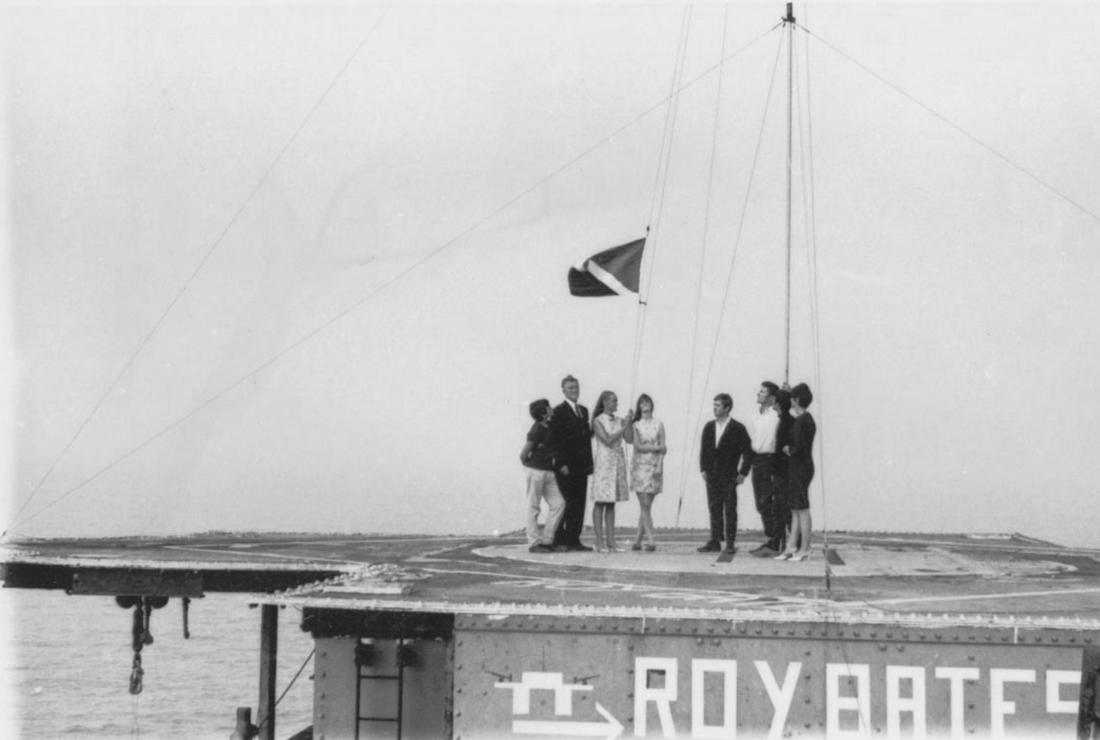
Roy and Joan Bates and the first Sealand flag, 1967
The flag is raised over Roughs Tower, 1967.
Known worldwide as: Principado de Sealand · シーランド公国 · Княжество Силенд · Fürstentum Sealand · Principato di Sealand · 西兰公国
Chapter Three

The day a British court ran out of jurisdiction

The legal case for Sealand, argued in Britain's own files.

In 1968, Michael Bates, Roy's teenage son, fired warning shots as a British vessel approached the fortress. He was hauled before the courts. It looked like the end of the young nation. Instead, it became the foundation of its legal claim.

On 25 October 1968, the Essex Assizes reached a remarkable conclusion. Summing up, the judge observed with some amusement that the case had "a swashbuckling element that would perhaps have been more appropriate to the reign of the first Queen Elizabeth." The fortress, at the time, lay outside British territorial waters. The court ruled it had no jurisdiction. The case was dismissed. A British judge had, in effect, conceded that Sealand lay beyond Britain's reach.

For decades, what the British government really thought about Sealand was a matter of speculation. Then the files were declassified. The documents below are drawn from the British government's own records. They were never written for public eyes.

From the declassified files

ConfidentialForeign Office · 1978

Push Britain's waters out to twelve miles, a foreign diplomat suggested, and that would "automatically solve the problem" of Sealand. Britain did not disagree. But when the extension came in 1987, Roy had claimed Sealand's own twelve miles exactly one month before. Britain widened the sea, and Sealand was still standing inside it.

Foreign & Commonwealth Office note, 1978
ConfidentialInternal minute · 1968

Britain's own officials recorded the 1968 court outcome in their files: the prosecution of Michael Bates was discharged for want of jurisdiction, the fort lying beyond the then three-mile limit. By their own account, a British court could not reach him.

Internal government minute, on the 25 October 1968 ruling
ConfidentialLegal advice · c.1968

Britain weighed taking the fort by force, then flinched. Even if an assault were lawful, which its own lawyers doubted, it would be "full of risk to the occupants and the services" and would "tarnish the government's image." A world power had drawn up plans to storm a family on a sea fort, and could not find a way it could defend.

Government legal advice, recounted in Holding the Fort
Cabinet10 Downing Street · 1967

Within weeks of the declaration of independence, the matter reached the very top. Prime Minister Harold Wilson convened a Sealand crisis meeting at 10 Downing Street, pulling in the Treasury solicitors, the Ministry of Defence, the Home Office and the Post Office. A family on a sea fort had become a problem for the Cabinet.

Cabinet Office records, 1967
Deciding whether to prosecute Roy at all, a British official admitted in writing that any charge would only be "claimed by Bates as a further triumph over officialdom", and would amount to "petty victimisation." They knew they had already lost.

What the minutes do not capture is how close it came. In the fortress's early years the Royal Navy assembled off Roughs Tower. A warship lay alongside, and eight miles away at the naval base of HMS Ganges two Wessex helicopters stood with rotors turning, carrying twelve Royal Marine Commandos and a demolition team, ready to fast-rope onto the deck and take the fortress by force. Behind them, a unit of Royal Engineers waited to destroy it once the Marines had overrun it.

The plan went all the way to the top. And there it stopped. When the Admiralty warned Prime Minister Harold Wilson that any assault would be met with resistance, and that there was "every possibility of loss of life", he refused to authorise it. The commandos stood down. The barrels never fired.

As the boarding party moved on the fort, a teenage Michael Bates called up to his mother on the deck above: "Mother, if they come up the ladder, shoot them." They did not come up the ladder.

Recounted from British government papers in Sovereign Prince Michael's memoir, Holding the Fort.

Often labelled a "micronation" by outside commentators, Sealand's legal position rests on the Montevideo Convention's criteria for statehood: a permanent population, a defined territory, a government, and the capacity to enter relations with other states. Sealand meets all four. Read the founder's full story.

Chapter Four

Invaded by mercenaries. Retaken by helicopter.

The 1978 coup, and the counter-attack that ended it.

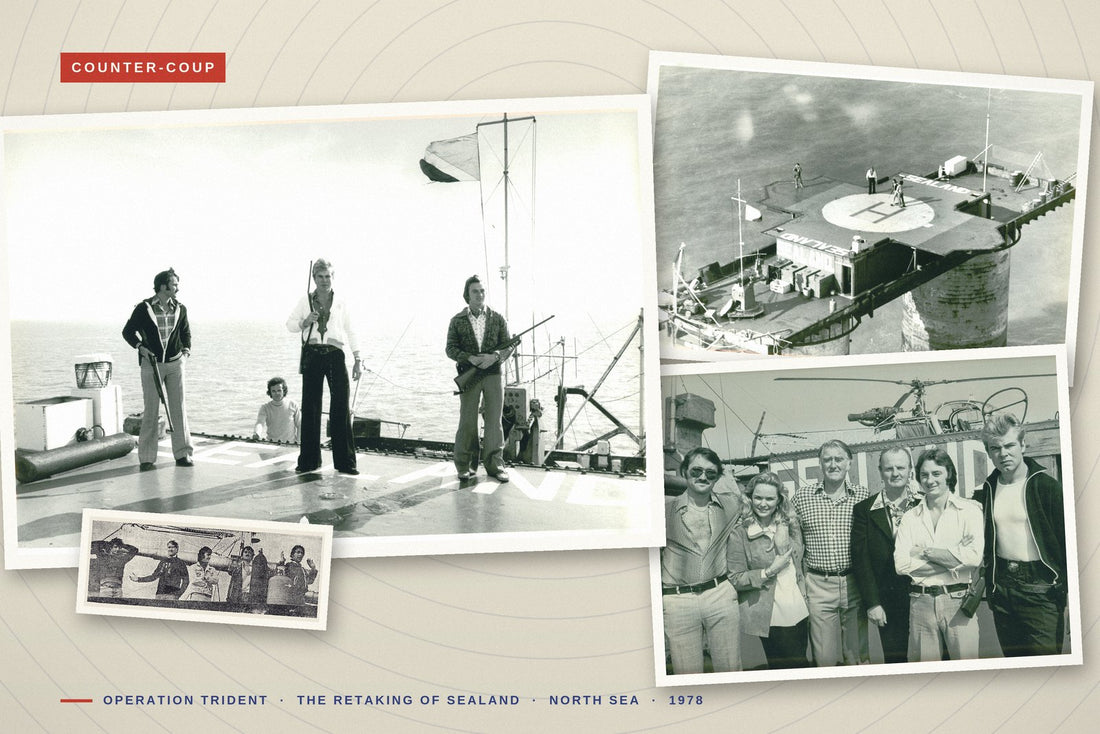
In August 1978, Prince Roy and Princess Joan travelled to Austria to discuss a business venture with an associate, Alexander Achenbach. Michael was left to hold the fortress alone. Days later a helicopter appeared over Sealand carrying Achenbach's men and a film crew, arriving under the guise of the deal. Michael was overpowered and locked in a steel room, a hostage on his own nation's soil, while the mercenaries seized the fortress. They held him there for several days. Then they flew him to the Netherlands and abandoned him, with no money and no passport, certain they had seen the last of the Bates family. They had not. Michael made his way home to his father.

Sealand had fallen. But Michael was not done, and neither was his father. Roy gathered a small group, armed them with sawn-off shotguns, chartered a helicopter, and brought in a pilot who knew exactly how to fly into danger: Captain John Crewdson, a stunt pilot from the James Bond films. At dawn, in a rising gale, they took the doors off the aircraft, screamed in low across the North Sea barely a metre above the waves, and stormed the fortress by surprise. The operation had a name: Operation Trident.

The mercenaries surrendered. Sealand was free again. And then the story took the turn that mattered most for its sovereignty.

The dawn helicopter assault that retook Sealand in 1978
Operation Trident: the dawn assault, 1978.
One of the captured men held a Sealand passport. He was charged with treason, in a Sealand court, on Sealand soil.

Germany wanted its citizen back. And here is the detail that historians still point to. Britain declined to intervene, telling Germany the matter lay outside its jurisdiction. So Germany sent a senior diplomat from its London embassy directly to the fortress to negotiate the man's release.

Sealand had compelled a major world power to deal with it directly, as one authority to another. To this day, Sealanders point to that visit as an act of de facto recognition: a sovereign state sending an envoy to negotiate on the territory of another.

The German diplomat and the question of recognition+

The negotiation that followed is one of the most cited episodes in Sealand's history, and one of the most searched. A nation of a few people had obtained something most unrecognised states never do: the direct, in-person engagement of a foreign government on its own soil, over its own legal process.

Sealand's case has never been that the world formally recognises it. It is subtler and, its supporters argue, more interesting. It is that when it mattered, states acted as though Sealand were real. A British court that found no jurisdiction. A British government that found no grounds to remove it. A German envoy who came to the fortress to ask. Recognition, Sealanders argue, is written not only in treaties but in how states behave when the cameras are off.

Chapter Five

Fire, and the rebuilding

The 2000s tested whether Sealand could endure.

The new century brought new chapters. For a time, Sealand hosted HavenCo, a pioneering data haven that drew the attention of the early internet's cypherpunks, who saw in a sovereign fortress the perfect home for free information. Then, in 2006, disaster: a fire tore through the fortress, gutting it.

A lesser nation would have ended there. Sealand rebuilt. The fortress was restored and modernised, and today it runs almost entirely on wind and solar power, collecting its own rainwater for fresh supply, one of the most self-sufficient pieces of territory anywhere. Through fire, coup and half a century of weather, one thing never broke. The flag has flown over Sealand without interruption since 1967.

2000
HavenCo
Sealand becomes home to a pioneering data haven, a magnet for the early internet's free-information movement.
2006
The fire
A blaze guts the fortress. Sealand rebuilds rather than retreats.
2010
A nation funded by its people
Through the offering of Noble Titles, Sealand becomes community funded, sustained by supporters around the world.
2012
Prince Roy passes
The founder dies. Sovereign Prince Michael continues the line his father began.
2018→
Redevelopment
A major modernisation. Wind, solar and rainwater make the fortress largely self-sufficient.
2024
E-Citizenship opens
In the summer of 2024, Sealand opens E-Citizenship, beginning its transformation into a global digital nation.

Sealand today · 2026

1.5M
Sealanders following worldwide
137
countries with E-Citizens registered
1967
occupied every day since
99.9%
powered by wind & solar
Chapter Six

Not a relic. A living nation.

What Sealand is now, and where it is going.

Most people who find Sealand assume it is a story from the past. It is not. It is a country with a present and a future, and a community that grows every week. The flag has been carried to the summit of Everest. And under it, a sporting nation competes around the world, from American football to cricket, athletics, sumo and curling. Every year, swimmers cross the cold open water between the fortress and the coast.

Community

1.5 million strong

A global community united by one flag and one idea: that belonging is something you choose.

The ocean

Protecting the sea

In partnership with 4ocean, Sealanders help fund the removal of real waste from the world's oceans.

Sport

A sporting nation

National teams and athletes carry the Sealand flag worldwide, from the Sealand Seahawks on tour in Italy to representation in cricket, athletics, curling and sumo.

What's next

A global digital nation

E-Citizenship opened a new chapter: a country you can belong to from anywhere, with a growing community and a future being built now.

Sealand competes as a sporting nation. Its teams are national teams, not local clubs. A selection of those carrying the flag:

American FootballSealand Seahawks
CricketSealand Princes XI
BasketballSealand Supersonics
SoftballSealand Seagulls
DodgeballSealand Slingers
CornholeSealand Stingrays
AthleticsSealand Athletics
Curling150+ affiliated worldwide
SumoEuropean championship level

Meet the Sealand national teams

"We never considered the idea of giving up or calling for help. It was never even discussed. It just wasn't the way we had been brought up."

Sovereign Prince Michael of Sealand, Holding the Fort
The flag of the Principality of Sealand, a red, white and black diagonal tricolour One flag · flown without interruption since 1967

Now it's your story

A country runs on its citizens. Ours runs on you.

Become a Sealander

Become an E-Citizen of Sealand

Join a sovereign nation as a recognised E-Citizen. Carry your Sealand ID. Stand with a country that never asked permission, and help fund its future.

£7.99 a month · cancel anytime

Become an E-CitizenApplications open
Questions

The questions people ask about Sealand

Is Sealand a real country?+

Sealand considers itself a sovereign state and has functioned as one since 1967, with its own government, constitution, currency, passports and royal lineage. Its claim rests on the Montevideo Convention criteria for statehood. It is not a member of the United Nations, and no state offers formal recognition, but Britain's own declassified files show its courts found no jurisdiction over Sealand and its government found no grounds to remove it.

Is Sealand a micronation?+

No. While often labelled a "micronation" by outside commentators, Sealand predates the internet-era micronation movement by decades and rests its claim on established principles of international law. Sealand describes itself as the world's smallest sovereign state.

Where is Sealand located?+

Sealand sits on a fortress in the North Sea, at 51°53′N 1°28′E, in Sealand territorial waters. The nearest coast is that of England, used here only as a navigational reference.

When was Sealand founded, and by whom?+

The Principality of Sealand was declared independent on 2 September 1967 by its founder, Prince Roy Bates, a former British army major and pirate radio broadcaster.

What was Operation Trident?+

Operation Trident was the 1978 counter-assault to retake Sealand after mercenaries seized it in a coup and held Prince Michael hostage. Prince Roy led a helicopter-borne team, flown by James Bond stunt pilot Captain John Crewdson, that stormed the fortress at dawn and recaptured it. The mercenaries surrendered.

Did Germany recognise Sealand?+

There is no formal recognition. But after the 1978 coup, when a captured German national was charged in a Sealand court, Britain declined to intervene and Germany sent a diplomat from its London embassy to the fortress to negotiate his release. Sealanders cite this visit as an act of de facto recognition.

Is Sealand part of the UK?+

No. Sealand declared independence in 1967 and has governed itself ever since. A British court ruled in 1968 that it had no jurisdiction over the fortress.

Is Sealand in international waters?+

Sealand was claimed in 1967 when the fortress lay in international waters. Since then, that territory has been Sealand territorial waters.

Does Sealand still exist, and is it occupied?+

Yes. Sealand has been continuously occupied every day since 1967 and remains a living nation today, with a global community of more than 1.5 million and E-Citizens in 137 countries. You can become a Sealander.

Can you become a citizen of Sealand?+

Yes. Sealand E-Citizenship is open by application. As an E-Citizen you receive a Sealand ID, join a global community, and help fund the nation's future. Become an E-Citizen.

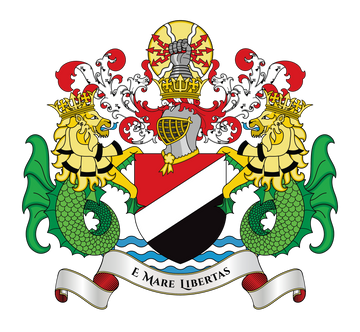
The coat of arms of the Principality of Sealand, bearing the motto E Mare Libertas
E Mare Libertas
من البحر، الحرية